
Context Engineering in Data Engineering
How context engineering will affect the data engineers

I‘m Subhan Hagverdiyev and welcome to Dataheimer - where we explore the atomic impact of data.
Just like splitting an atom releases enormous energy, the right data engineering decisions can transform entire organizations.
This is where I break down complex concepts and share all the fascinating discoveries from my journey.
Want to join the adventure? Here you go:
A few years ago, most conversations about data systems revolved around scale: more rows, faster queries, cheaper storage. Lately, the tone has shifted. Teams are still chasing performance, but they are also wrestling with a subtler problem—how systems understand the situation they’re operating in.
That’s where context engineering comes in.
The Tweet That Started It All
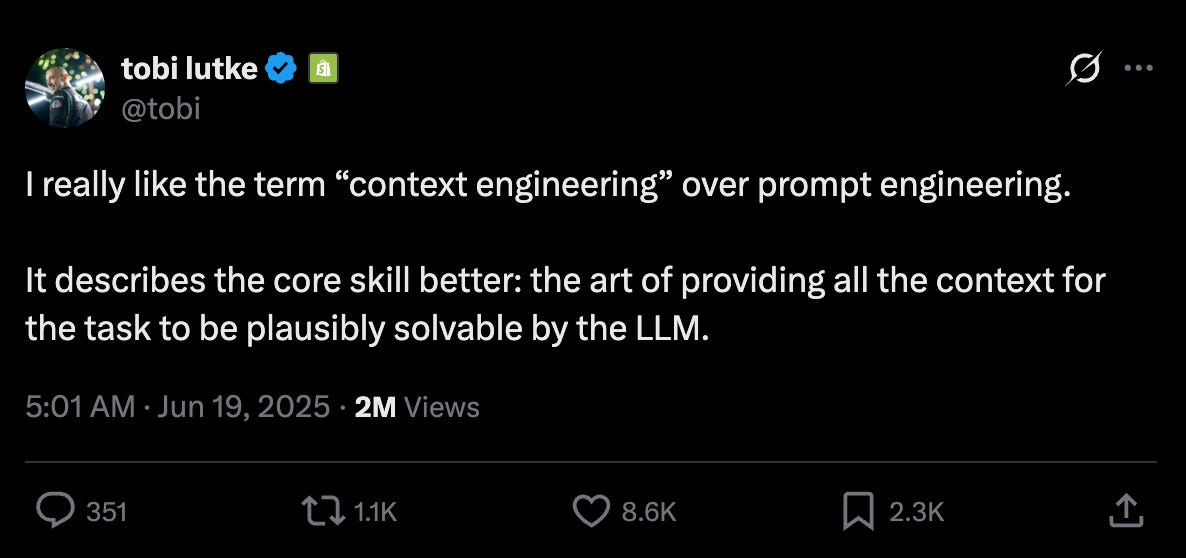
In June 2025, Shopify CEO Tobi Lütke posted something that made waves in AI commnity.Andrej Karpathy—yes, that Karpathy—immediately co-signed it. His take was more technical but hit the same nerve:
"People associate prompts with short task descriptions you'd give an LLM in your day-to-day use. When in every industrial-strength LLM app, context engineering is the delicate art and science of filling the context window with just the right information for the next step."
So What Is Context Engineering, Really?
Here’s my working definition: Context engineering is the discipline of designing and optimizing the entire information environment that an LLM operates in—not just the prompt, but everything the model sees at inference time.
That includes:
System instructions (the static stuff that tells the model how to behave)
Retrieved knowledge (documents, database records, whatever you pulled from your RAG pipeline)
Tool definitions (what functions the model can call)
Conversation history (what’s been said before)
User metadata (who’s asking, what permissions they have, what timezone they’re in)
State (what step are we on, what’s already been tried)
How context shows up inside data engineering
For data engineering teams, context engineering is not merely an extension of existing ETL (Extract, Transform, Load) processes but a fundamental revaluation of what constitutes "data readiness". Traditionally, data engineering focused on moving raw digital signals into passive storage for human consumption. In the context-engineered enterprise, pipelines are redesigned to deliver "executable understanding"—data that is enriched with the semantic, structural, and operational metadata required for machines to act autonomously
Semantic Context and the Unified Meaning Layer
The first pillar of data-centric context engineering is semantic context, which ensures that machines and humans share a canonical understanding of business concepts. In complex enterprise environments, metric logic—such as the definition of "revenue" or "customer churn"—often varies across departments. Context engineering mandates that these definitions be centralized, versioned, and programmatically discoverable. Without this semantic grounding, AI agents frequently suffer from reasoning failures caused by mismatches in metric logic rather than model flaws.
Structural Context: Lineage as a Reasoning Graph
Lineage has transitioned from a passive compliance requirement to an active reasoning backbone. Agents require structural context to navigate the interconnected landscape of enterprise data, utilizing lineage graphs to trace anomalies upstream, estimate the “blast radius” of potential actions, and choose alternative data paths when a primary source is unavailable. This transformation often involves the use of knowledge graphs that link physical data assets (tables and columns) to business metrics and transformations.
Operational Context and Probabilistic Trust
Unlike traditional data quality monitoring, which treats trust as a binary (certified or uncertified), context engineering views trust as a dynamic, use-case dependent signal. Operational context includes real-time telemetry on data freshness, distribution shifts, and historical reliability patterns. For an agentic system, a dataset may be considered “good enough” for an internal forecast but “unsafe” for regulatory reporting; context engineering encodes this nuance, allowing agents to explain why a decision is safe or unsafe based on the current state of the underlying data.
Policy Context and Enforceable Constraints
The final data pillar is policy context, which ensures that agents operate within the legal, ethical, and regulatory boundaries of the organization. This involves embedding sensitivity classifications, regional constraints, and purpose limitations directly into the data context. These constraints must be machine-readable and enforced at decision time, providing an auditable trail of how data was used and for what purpose.
The realization of context-aware systems requires a significant upgrade to the traditional data stack, moving from simple relational tables to multidimensional vector databases and semantic graphs. These technologies provide the foundational "RAM" required for contextual understanding at scale. Although this is also quite important concept this will be discussed later in another article.
Wrapping Up
For data engineers, this is both a challenge and an opportunity. A challenge because the expectations are higher than ever. An opportunity because the skills you've built over years of pipeline work translate directly to this new domain.
Have thoughts on context engineering in your data stack? I'd love to hear what patterns you're seeing. The field is moving fast and none of us have all the answers.